At some point, most homeowners face the same nagging question: is this roof problem something a repair can fix, or is it time for a full replacement? It is one of the more stressful home decisions, because the two paths carry very different price tags, and picking wrong in either direction costs you money.
Repair too many times on a roof that is failing, and you throw good money after bad. Replace a roof that had years of life left, and you spend thousands you did not need to. The goal of this guide is to help you read the signs, weigh your roof’s age and condition, and understand how a professional makes the call, so you can walk into that decision with confidence.
We are Roof Masters & Exteriors, and we inspect and work on roofs across the Indianapolis metro every week. Indiana’s mix of hard winters, spring hail, and summer storms puts local roofs through a lot, and it pushes plenty of homeowners into this repair-or-replace question sooner than they expected.
For general guidance on roof service life and replacement standards, the National Roofing Contractors Association is a solid reference. Below, we break the decision down into the factors that matter most.
Repair or Replace? The Core Question
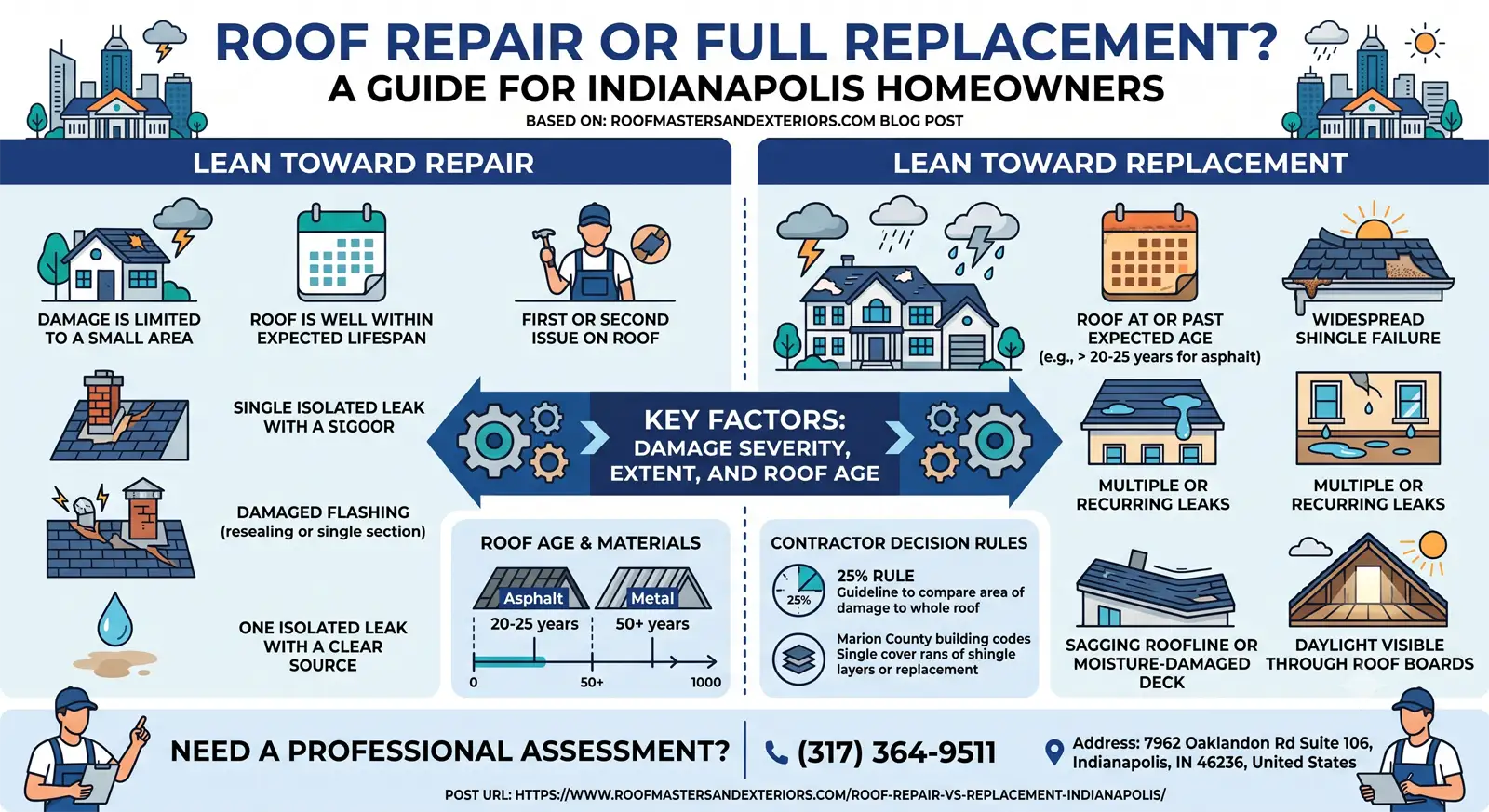
The repair-versus-replacement decision often comes down to three things: how bad the damage is, how much of the roof it affects, and how old the roof already is. A single problem area on a young roof almost always points to repair. Widespread problems, or any problem on a roof near the end of its life, tend to point toward replacement.
Here is a simple way to think about which direction your situation leans:
| Lean Toward Repair | Lean Toward Replacement |
| Damage is limited to one small area | Damage is spread across large sections |
| Roof is well within its expected lifespan | Roof is at or past its expected age |
| A few missing or cracked shingles | Widespread curling, bald, or missing shingles |
| One isolated leak with a clear source | Multiple leaks or recurring leaks |
| Flashing or a small section needs sealing | The deck is sagging or has moisture damage |
| First or second issue on the roof | You have already repaired the roof several times |
Most real situations fall somewhere in the middle, which is why an honest inspection matters so much. The sections below walk through each signal in more detail.
Signs Your Roof Needs Repair
Not every problem means a new roof. Many issues are contained and straightforward to fix, and catching them early is what keeps a small repair from turning into a big one.
A handful of missing, cracked, or lifted shingles after a storm is a classic repair job. So is damaged or loose flashing around a chimney, vent, or skylight, since flashing is a common leak point that can be resealed or replaced on its own. A single leak that traces back to one clear source, minor granule loss in one area, or a small section of storm damage all fall into repair territory. If the rest of the roof is sound and the trouble is isolated, a targeted roof repair restores the system without the cost of a full tear-off.
The key word is isolated. One problem, one location, on an otherwise healthy roof, is the profile of a good repair candidate.
Signs You Need a Full Roof Replacement
Some signals point past repair and toward a new roof. When you see several of these at once, patching becomes a losing game.
Widespread shingle failure is the clearest sign: curling, cupping, cracking, or bald spots across large areas mean the shingles have reached the end of their service life, not just one damaged corner. Granules collecting in your gutters and downspouts in quantity tell the same story, since those granules are the shingle’s protective layer wearing away. Multiple leaks, or leaks that keep coming back after repairs, suggest the underlying system has failed. A sagging roofline or a spongy, soft deck points to moisture damage in the structure itself, which no surface patch can fix. And daylight visible through the roof boards in the attic means water is getting in unchecked.
When the evidence stacks up like this, a full roof replacement is the sound investment. It resets the clock on the entire system rather than buying a few months on a roof that will keep failing. New roof installation also gives you the chance to upgrade materials, improve ventilation, and pair the new roof with fresh gutter installation while the old roof is off.
How Roof Age Factors Into the Decision
Age is one of the biggest tiebreakers in the repair-or-replace decision. A standard asphalt shingle roof lasts about 20 to 25 years in the Indianapolis climate, though a well-cared-for roof can push toward the upper end and a neglected one falls short. Architectural shingles, metal, and other premium materials last longer.
This is where a common question comes up: does a 20 year old roof need to be replaced? Not always, but at that age you should treat every new problem with more suspicion. Spending money to repair a roof that is near the end of its life often means you are patching a roof you will replace within a year or two anyway. On a roof that is only 5 or 10 years old, the math flips, and repair is almost always the right move. If your roof is closing in on its expected age and starting to show trouble, that timing alone can tip the decision toward replacement.
The 25% Rule and How Contractors Decide
You may run into the “25% rule” while researching this decision. It is a guideline many contractors and insurers use: when a repair would involve more than about 25 percent of the roof, replacement often makes more financial sense than another patch, and some building codes require a full tear-off rather than layering new shingles over old past that point. In Marion County, for example, local building rules allow only so many shingle layers before a tear-off and reroof is required, and a structural permit applies to the work.
So how do you know if you should repair your roof or not? A good roof inspection answers the question with evidence instead of guesswork. A qualified contractor looks at the extent of the damage, the age and condition of the shingles, the state of the decking and flashing underneath, and your repair history, then gives you a straight recommendation with the reasoning behind it. A trustworthy contractor will tell you when a repair is the smarter call, not push a replacement you do not need.
What About Cost?
Cost is the elephant in the room, and it is a fair thing to weigh. A repair is a fraction of the price of a replacement, which is why repeated repairs on a failing roof are a trap: three or four repair bills can add up to a meaningful chunk of a new roof, with none of the long-term value.
Roof replacement cost depends on the size and pitch of your roof, the materials you choose, and the condition of the deck underneath. If you need a new roof but are worried about affording it, ask about financing options and get a written estimate before you rule it out. Many homeowners also wonder about timing: the cheapest time of year for a new roof is often late fall or winter, when demand slows down, though waiting on a roof with heavy damage through another storm season can cost more than you save. Our residential roofing team provides clear, itemized estimates so you can see in full what you are paying for.
Should You Replace a Roof That Isn’t Leaking?
It feels strange to replace a roof that is not yet leaking, but sometimes it is the right move. A roof can be at the end of its life, with widespread shingle failure and thinning protection, before a leak ever shows up inside. Waiting for the first leak means waiting for water to already be in your deck, insulation, or ceiling, where the damage is far more expensive to undo.
If an inspection shows your roof is worn out across the board, replacing it before it leaks is a preventive move, not a wasteful one. It lets you plan the project on your schedule rather than scrambling after the next storm opens a hole.
Working With Your Insurance Adjuster
If storm or hail damage is behind your roof trouble, your homeowners insurance may cover a repair or replacement. Prompt documentation matters, since insurers set deadlines for filing claims, and hail damage is not always visible from the ground. A professional look at storm damaged roofing gives you the evidence a claim needs.
A common question is what not to say to a roof insurance adjuster. Industry guidance from the Insurance Information Institute on how to file a homeowners claim is worth reading before the visit. The short version: stick to the facts, do not guess at the age of the damage or admit to deferred maintenance you are unsure about, and do not downplay or exaggerate what happened. Let the documented inspection speak for the condition of the roof. Having an experienced roofer present during the adjuster’s visit helps make sure the full scope of the damage is on the record.
When to Call a Professional Roofer or Roofing Contractor
You can spot many of these warning signs from the ground, but the repair-or-replace decision itself is best made with a professional roofer’s eyes on the roof and in the attic. Much of what determines the answer, the condition of the decking, the flashing, and the underlayment, is not visible from the driveway.
A licensed roofing contractor brings the training, the fall-protection equipment, and the insurance to inspect the roof without adding damage, and a reputable one documents everything so you understand the recommendation. When you are comparing quotes, look for a roofing contractor who explains the why behind repair or replacement, not just the price.
If you want a straight answer on your roof, Roof Masters & Exteriors serves homeowners across the Indianapolis area. Explore our full range of Indianapolis roofing services, browse our roofing project gallery and customer testimonials, or, if you have been searching for roofers near me, call (317) 364-9511 to schedule an inspection.
Get a Clear Answer on Your Roof
The repair-or-replace decision does not have to be a guessing game. Read the signs, factor in your roof’s age, and get a professional inspection that gives you the facts. That combination protects both your home and your wallet from the wrong call in either direction.
If you would like an honest assessment of your roof, Roof Masters & Exteriors is here to help. Call (317) 364-9511, or contact our team to schedule an inspection.
Roof Masters & Exteriors
Address: 7962 Oaklandon Rd Suite 106, Indianapolis, IN 46236, United States
Phone Number: (317) 364-9511
Google Maps: Find Us Here
Business Hours:
Monday: 8:00 AM To 5:00 PM
Tuesday: 8:00 AM To 5:00 PM
Wednesday: 8:00 AM To 5:00 PM
Thursday: 8:00 AM To 5:00 PM
Friday: 8:00 AM To 5:00 PM
Saturday: 8:00 AM To 12:00 PM
Sunday: Closed
FAQs About Roof Repair vs. Full Replacement in Indianapolis, IN
How do I know if my roof needs a repair or a full replacement?
Isolated damage, like a few missing shingles or a single leak, on a roof still within its expected lifespan usually points to a repair. Widespread damage, multiple leaks, or a roof near the end of its life often points to a full replacement. A professional inspection settles the question with actual evidence.
What is the 25% rule in roofing?
The 25% rule is a common guideline among insurers and contractors: once a repair would involve more than about a quarter of the roof, replacement usually makes more financial sense than another patch, and some local codes require a full tear-off past that threshold.
How many roof leaks are too many before I should replace instead of repair?
There’s no fixed number, but recurring leaks in different areas of the roof, rather than one isolated spot, usually signal that the roofing system as a whole is failing rather than a single fixable problem.
How long does an asphalt shingle roof last in Indianapolis and Central Indiana?
Most asphalt shingle roofs in central Indiana last 20 to 30 years, though hail, high wind, and freeze-thaw cycles can push that number lower without regular maintenance. A roof approaching that range deserves closer inspection before deciding between repair and replacement.
Can storm damage be repaired, or does it always require a full roof replacement?
It depends on the extent of the damage. Isolated hail or wind damage can often be repaired, while widespread bruising, missing shingles across multiple slopes, or damage to the underlying deck usually calls for a full replacement.
Is it cheaper to repair my roof now and replace it later?
Sometimes, but not always. Repeated repairs on an aging roof can end up costing more over time than a single replacement, especially if each repair only addresses one symptom of a roof that’s failing more broadly.
Does homeowners insurance cover roof replacement or only repairs?
Coverage depends on the cause of the damage. Storm-related damage from a covered peril like wind or hail is often eligible for replacement coverage, while damage from age or lack of maintenance typically is not.
How do I know if my roof damage is bad enough to file an insurance claim?
If the damage came from a recent storm and affects a meaningful portion of the roof, it’s worth having a professional inspection and documentation before deciding, since insurers often set deadlines for filing after a covered event.