Your home’s siding does far more than set its look. It is the primary shield between the structure and everything Indiana weather throws at it, from January ice to July hail and humidity. So when it comes time to re-side, the material you pick shapes your budget, your maintenance routine, and how the house holds up for the next few decades.
For most Indianapolis homeowners, the choice comes down to two front-runners: vinyl and fiber cement. Vinyl is the budget-friendly, low-upkeep favorite that covers a huge share of American homes. Fiber cement, often known by the James Hardie brand name, is the tougher, more premium option that mimics wood and stands up to fire and impact. Neither is the right answer for every home, and the best pick depends on your goals, your timeline, and how long you plan to stay.
We are Roof Masters & Exteriors, and we install and repair both materials on homes across the Indianapolis metro. This guide breaks down how vinyl and fiber cement compare on cost, durability, energy efficiency, maintenance, and curb appeal, so you can walk into the decision knowing what each one gives you and what it asks in return.
By the end, you should have a clear sense of which material fits your home, plus honest answers to the questions homeowners ask us most, including how the two stack up against Hardie board and whether siding can affect your insurance.
Vinyl Siding vs. Fiber Cement Siding at a Glance
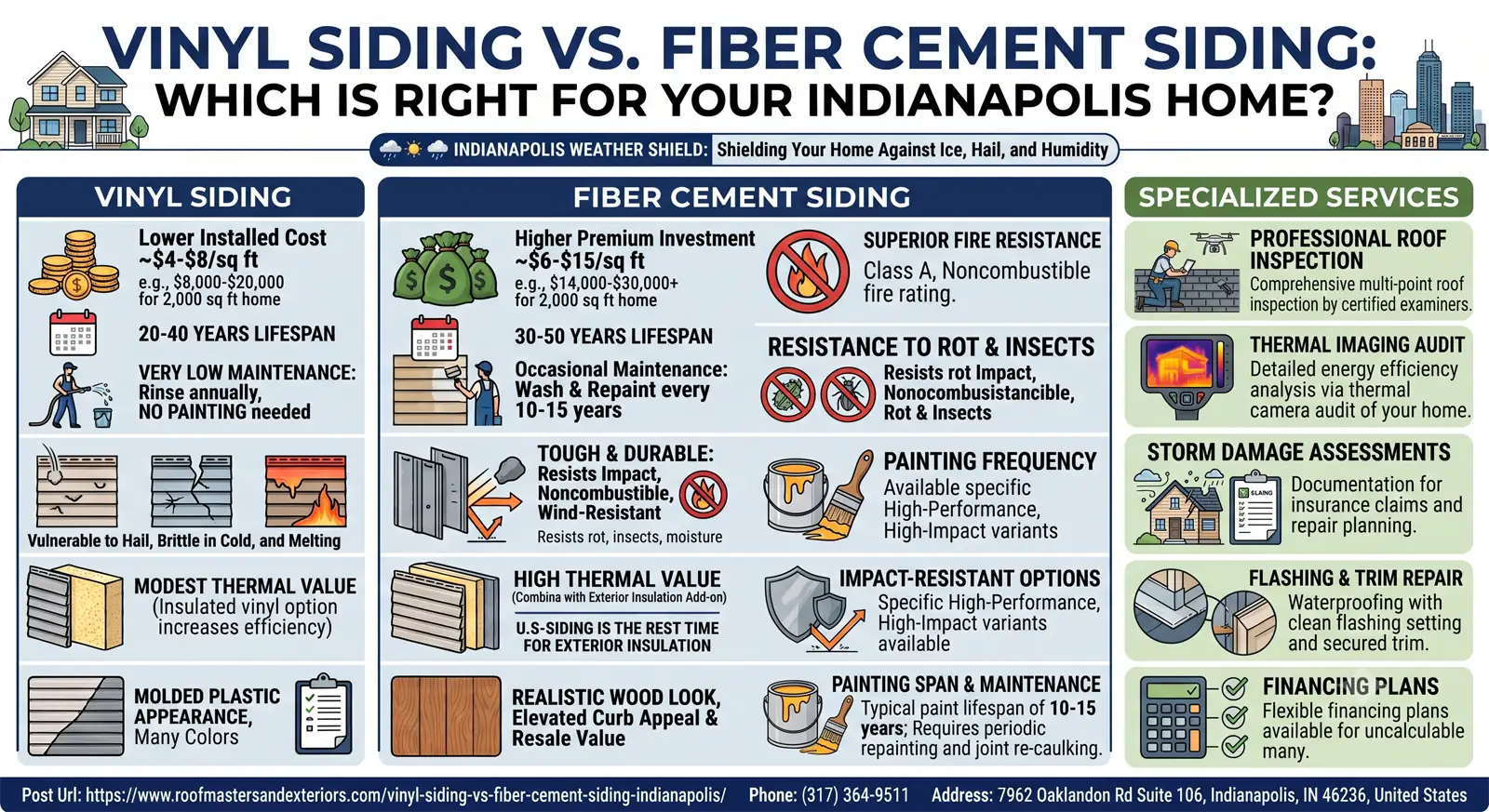
Before the detail, here is a side-by-side look at how the two materials compare on the factors that matter most to an Indianapolis home.
| Factor | Vinyl Siding | Fiber Cement Siding |
| Installed cost | Lower, about $4 to $8 per square foot | Higher, about $6 to $15 per square foot |
| Lifespan | 20 to 40 years | 30 to 50 years |
| Maintenance | Rinse once or twice a year, no painting | Wash and repaint every 10 to 15 years |
| Fire resistance | Melts and burns | Noncombustible |
| Impact and wind | Can crack in cold, dent from hail | Resists impact and high wind |
| Appearance | Good, molded plastic look | Excellent, close to real wood |
| Weight and install | Light, faster to install | Heavy, needs skilled crew |
These are broad ranges. The right figures for your project depend on your home’s size, wall condition, and the exact product line you choose. The sections below explain what drives each number.
What Is Vinyl Siding?
Vinyl siding is a molded PVC plastic cladding that has been the most popular siding in the country for years, and for good reason. It is affordable, comes in a wide range of colors and profiles, and asks very little of the homeowner once it is up.
The appeal is straightforward. Vinyl siding costs less to buy and less to install, since the panels are light and go up fast. The color runs through the material, so it never needs painting, and a rinse with a garden hose once or twice a season keeps it looking fresh. Modern insulated vinyl also adds a layer of foam backing that stiffens the panel and improves energy performance.
The trade-offs are real, though. Vinyl can crack in deep cold if it takes a hard hit, and large hail can dent or puncture it. It can warp or melt near intense heat, such as a grill placed too close to the wall. And while today’s vinyl looks better than the vinyl of twenty years ago, up close it still reads as molded plastic rather than wood.
What Is Fiber Cement Siding?
Fiber cement siding is a composite of cement, sand, and cellulose fibers pressed into planks or panels. It is heavier, denser, and more durable than vinyl, and it does a much better job of imitating the look of natural wood grain.
The strengths are where fiber cement earns its premium. Fiber cement siding is noncombustible, so it will not feed a fire the way vinyl does. It shrugs off impact from hail and debris, holds up to high wind, and resists rot, insects, and moisture. It also takes paint well and holds a crisp, high-end appearance that raises curb appeal and resale value.
The costs are the flip side. Fiber cement is more expensive to buy and to install, because the planks are heavy and demand a skilled crew and specialized cutting. It is not maintenance-free either: the material itself lasts for decades, but the paint finish needs refreshing every 10 to 15 years. For many Indianapolis homeowners, that added durability and looks are worth the higher price and the occasional repaint.
Cost Comparison: Vinyl vs. Fiber Cement Siding
Cost is the first thing most homeowners ask about, so let us put real numbers to it. Installed vinyl siding runs about $4 to $8 per square foot, while fiber cement lands higher at around $6 to $15 per square foot. The gap reflects both the material price and the labor, since fiber cement is heavier and slower to hang.
To translate that into a whole-home figure, take a 2,000 square foot house, which needs somewhere around 2,000 to 2,500 square feet of siding once you account for walls, gables, and waste. Vinyl for a home that size often falls in the ballpark of $8,000 to $20,000 installed, while fiber cement for the same home tends to run from about $14,000 to $30,000 or more, depending on the product line and the condition of the walls underneath.
What drives the number up or down? Home size and number of stories, the amount of trim and detail work, whether old siding must be torn off, the state of the sheathing beneath, and the specific brand and finish you select. The one way to know your real cost is a walk-through and a written estimate, which is why any credible quote starts with an on-site look rather than a phone-call guess.
Durability in Indianapolis Weather
Indiana gives siding a full workout: freeze-thaw swings, spring hail, summer storms, and stretches of humidity. How the two materials hold up under that stress is one of the biggest reasons to pick one over the other.
Fiber cement is the tougher of the two. Its density lets it resist hail impact and wind-driven debris, and it does not grow brittle in the cold the way vinyl can. Full-scale hail testing by the Insurance Institute for Business & Home Safety has put vinyl and fiber cement side by side to show how the two claddings respond to impact, and the denser material fares better. Vinyl still performs well for the money, and high-grade impact-rated vinyl narrows the gap, but standard vinyl is the more vulnerable choice when a hailstorm rolls through.
Because Indiana storms often hammer the roof and the walls in the same event, it is worth checking both after severe weather. If a storm has left you with damaged siding and a battered roof, our team handles storm damaged roofing alongside siding repair so the whole exterior gets addressed at once.
Energy Efficiency and Insulated Siding
Siding on its own is not a heavy-duty insulator, but the material and how it is installed do affect your energy bills. Standard vinyl and standard fiber cement both offer modest thermal value. The bigger lever is insulated siding or continuous exterior insulation added behind the panels.
Insulated vinyl bonds a layer of rigid foam to the back of each panel, which stiffens the siding and cuts down on thermal bridging through the wall studs. You can also add a continuous layer of exterior insulation under either material during a re-side. The U.S. Department of Energy notes that the best time to add continuous exterior insulation is when you are already planning to re-side, since the walls are exposed and the added cost is small next to the siding itself. If lower energy bills are a priority, that upgrade is worth pricing out while the old siding is off.
Maintenance and Lifespan
The two materials ask for different things over the years, and that difference adds up.
Vinyl is the low-maintenance champion. It never needs paint, and a rinse to clear dirt and mildew is about all it wants. Its weak points are cracking and fading over a long stretch of sun, and a damaged panel is replaced rather than patched. A vinyl job lasts about 20 to 40 years depending on grade and exposure.
Fiber cement lasts longer as a material, often 30 to 50 years, but it is not hands-off. The paint finish fades and chalks over time and needs refreshing every 10 to 15 years, and the caulk at joints and trim wants periodic attention to keep moisture out. Think of fiber cement as a longer-lived body that needs an occasional new coat, versus vinyl as a shorter-lived body that never needs painting.
Curb Appeal and Style Options
Looks matter, both for your daily enjoyment and for resale. Both materials come in lap (horizontal) and board and batten (vertical) styles, along with shakes and shingles for accents, so you are not boxed in on design with either one.
The difference shows up close. Fiber cement holds deep, crisp wood-grain textures and sharp shadow lines that read as genuine wood from the street, which is part of why it often lifts a home’s appraised value. Vinyl has come a long way and looks clean and tidy, and it offers the widest palette of baked-in colors, but under close inspection the molded surface still shows its plastic origins. If you are chasing a high-end, natural-wood appearance, fiber cement wins; if you want a broad color selection with no repainting, vinyl holds its own.
What About Hardie Board and Newer Siding Options?
Homeowners researching this decision run into two related questions: how does Hardie board fit in, and what is the newest type of siding worth considering?
Hardie board is not a separate category. It is the best-known brand of fiber cement, made by James Hardie, and it is engineered to stand up to wind, hail, and fire. When people compare “vinyl vs Hardie,” they are comparing vinyl to a premium fiber cement product. If you like the strengths of fiber cement and want a proven, warranty-backed name, Hardie is a strong option, though it carries the fiber cement price tag.
As for newer materials, engineered wood siding has grown popular as a middle path. It gives a warm, real-wood look at a weight and price between vinyl and fiber cement, and it installs faster than fiber cement, though it needs more moisture care over time. Composite and high-density insulated products are also expanding the field. For most Indianapolis homes, though, the core decision still comes down to vinyl versus fiber cement, with engineered wood as a worthwhile third option to price out.
Does Siding Affect Home Insurance?
It can. Insurers price policies in part on how well a home resists damage, so a noncombustible, impact-resistant material like fiber cement can earn a lower premium or a discount in some cases, in the same way that fire- and impact-resistant materials are rewarded elsewhere on the home. The savings vary by carrier and are not guaranteed, so the move is to ask your agent whether your material and its impact rating qualify for a break.
Vinyl does not disqualify you from coverage, and standard policies insure vinyl-clad homes every day. The point is that if you are weighing the higher cost of fiber cement, a possible insurance benefit, along with its longer life and storm resistance, belongs in the math.
Which Siding Is Right for Your Indianapolis Home?
Here is the short version. Choose vinyl if your priority is a lower upfront cost, minimal maintenance, and a wide color selection, and if you are comfortable with a material that reads as plastic up close and is more prone to hail and cold-weather damage. Choose fiber cement if you want maximum durability, a genuine wood look, fire resistance, and a longer service life, and you are willing to pay more upfront and repaint every decade or so.
Budget, how long you plan to stay in the home, and how much the exterior’s appearance matters to you are the three questions that settle most decisions. And a re-side is a natural moment to handle other exterior work at the same time, from fresh gutter installation to a roof check, since the crew is already on site. Our full range of siding and exterior services covers both materials and the surrounding trim, flashing, and gutters that make a siding job perform.
Get Expert Help Choosing Your Siding
The right siding balances your budget, your maintenance tolerance, and the look you want for your home, all against Indiana’s demanding weather. Both vinyl and fiber cement are solid choices; the best one is the one that fits your priorities.
If you would like a straight recommendation and a written estimate, Roof Masters & Exteriors is here to help. Browse our project gallery to see completed exteriors, read our customer testimonials, or explore our full lineup of Indianapolis roofing services. Call (317) 364-9511, or contact our team to schedule a consultation.
Roof Masters & Exteriors
Address: 7962 Oaklandon Rd Suite 106, Indianapolis, IN 46236, United States
Phone Number: (317) 364-9511
Google Maps: Find Us Here
Business Hours:
Monday: 8:00 AM To 5:00 PM
Tuesday: 8:00 AM To 5:00 PM
Wednesday: 8:00 AM To 5:00 PM
Thursday: 8:00 AM To 5:00 PM
Friday: 8:00 AM To 5:00 PM
Saturday: 8:00 AM To 12:00 PM
Sunday: Closed
FAQs About Vinyl Siding vs. Fiber Cement Siding
Which is cheaper, vinyl siding or fiber cement siding?
Vinyl siding has a lower upfront installation cost than fiber cement, making it the more budget-friendly option for most Indianapolis homeowners. Fiber cement costs more initially due to material and labor requirements, but it can offer better long-term value through a longer lifespan.
How long does vinyl siding last compared to fiber cement?
Vinyl siding typically lasts 30 to 40 years, while fiber cement can last 50 years or more when properly installed and maintained. Both materials hold up well in Indianapolis when installed correctly, but fiber cement generally has the longer service life.
Which siding holds up better against hail in central Indiana?
Fiber cement offers exceptional impact and hail resistance thanks to its solid cement core, while vinyl provides moderate resistance since its flexible panels can crack under a hard enough impact. Homes in hail-prone areas often benefit from fiber cement’s added durability.
Does vinyl or fiber cement siding require more maintenance?
Vinyl siding requires very little maintenance beyond an occasional wash. Fiber cement is also low maintenance but typically needs repainting after 15 or more years to maintain its color and protective seal.
Is fiber cement siding fireproof?
Fiber cement is non-combustible and meets a fire performance standard that vinyl cannot match, since vinyl can melt under severe heat. This makes fiber cement a stronger choice for homeowners prioritizing fire resistance.
Can vinyl siding look as good as fiber cement?
Modern vinyl siding has improved significantly and offers a wide range of colors and textures, but fiber cement generally delivers a more authentic wood-like appearance with deeper grain detail. The right choice often comes down to budget versus aesthetic priorities.
Does my HOA affect whether I can install vinyl or fiber cement siding?
Yes, in some cases. Certain planned communities in the Indianapolis area, including parts of Carmel and Westfield, have HOA guidelines that restrict siding colors or materials, so it’s worth checking your HOA’s rules before choosing either option.
Which siding is better for energy efficiency, vinyl or fiber cement?
Insulated vinyl siding options can add meaningful R-value to your walls, while standard fiber cement doesn’t inherently improve insulation on its own. Either material can be paired with additional insulation during installation to improve energy efficiency.
Do I need to remove my old siding before installing either vinyl or fiber cement?
Yes. A complete tear-off is recommended for both materials, since installing new siding over old panels traps existing moisture, hides structural damage, and prevents a proper weather barrier from being installed underneath.
Which siding material is best for an older Indianapolis home?
It depends on the home’s architectural style and the homeowner’s priorities. Fiber cement often suits historic or traditional homes better due to its authentic wood-grain appearance, while vinyl offers a more budget-friendly option for homeowners prioritizing low maintenance over historical accuracy.